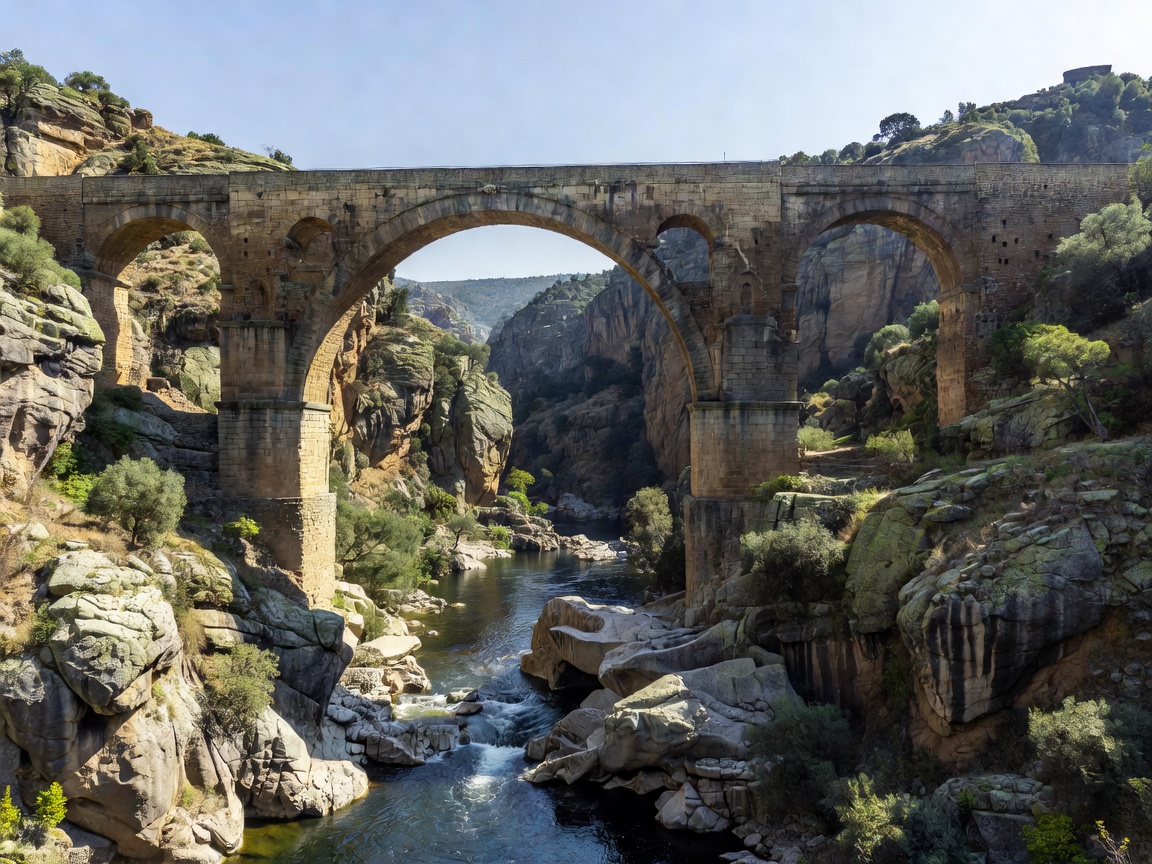
Engineering Defiance: 2,000 Years of Turbulent Floods
Commissioned by a confederation of twelve Lusitanian municipalities under the direction of architect Gaius Julius Lacer, the bridge was conceived to connect Norba Caesarina (Cáceres) to Conimbriga (Portugal).
The central river arch spans an incredible 28.8 meters across the chasm, reaching a height of 45 meters above the seasonal low water level. The structure was engineered specifically to endure the colossal flash floods of the Tagus, which historically swelled the river by more than 30 meters during winter storms.
The Inscription of Gaius Julius Lacer
Over Trajan's triumphal arch in the center of the bridge, the architect inscribed in Latin: "Pontem perpetui mansurum in saecula mundi fecit divina nobilis arte Lacer" — "Lacer, renowned for his divine art, built this bridge destined to endure through the ages of the world."
The Order of Alcántara and Frontier Warfare
During the Middle Ages and the Reconquista, the bridge became the spiritual and military stronghold of the Military Order of Alcántara. Because of its pivotal strategic position as the sole crossing point of the lower Tagus, arches were severed during the War of the Spanish Succession and the Peninsular War, yet meticulously reconstructed to Roman specifications.
The International Frontier: The Tagus as Border
Just downstream from Alcántara, the Tagus begins its role as the Tajo Internacional / Tejo Internacional, serving as the physical border between Spain and Portugal for 47 kilometers before entering Portuguese soil entirely near Cedillo.