The Natural Moat: Geomorphology of the Toledo Loop
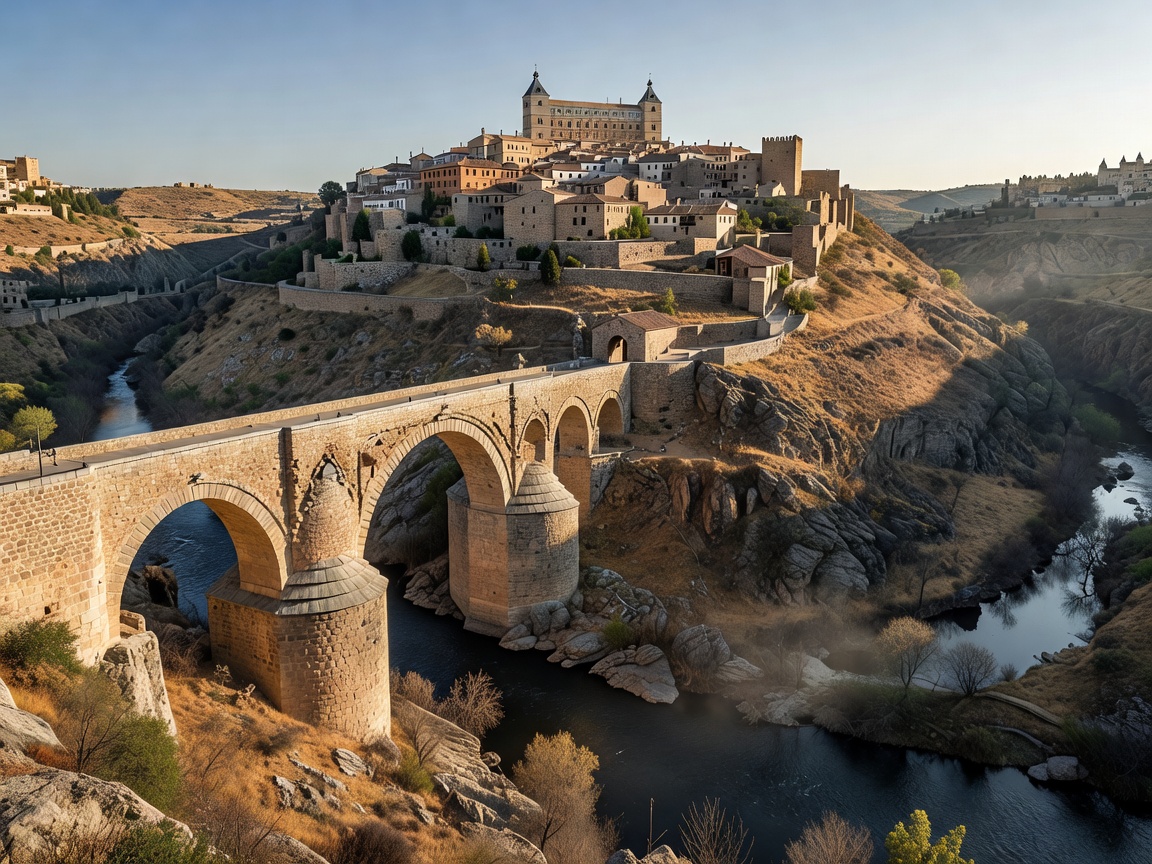
Rising high in the Montes Universales at Fuente de García, the Tagus flows west across the arid Castilian plain. Upon meeting the resistant granite pluton of Toledo, the river forms a sweeping 270-degree incised meander. This sheer, 80-meter canyon created a fortress city requiring defensive fortifications on only one vulnerable northern flank.
For centuries, the rapid current through the gorge powered essential grain mills, hydro-mechanical water lifts, and sword-forging workshops that made Toledo steel famous across the Renaissance world.
Key Architectural Highlight: Puente de San Martín & Puente de Alcántara
Two historic bridges span the torrential Tagus in Toledo. The eastern Puente de Alcántara has Roman foundations fortified during Moorish rule, while the western Puente de San Martín—erected in the late 14th century—boasts five imposing gothic arches and medieval defense towers designed to repel naval or terrestrial assault.
The City of Three Cultures: Convergence Along the Bank
During the 10th to 13th centuries, Toledo was the intellectual epicenter of Europe. In the shade of the Tagus riverbanks, scholars at the Toledo School of Translators rendered classical Arabic, Hebrew, and Greek mathematical and philosophical manuscripts into Latin, seeding the Italian Renaissance.
- Santa María la Blanca: 12th-century mudéjar synagogue built under Christian kings by Islamic artisans.
- Mosque of Cristo de la Luz: Erected in 999 AD with brick vaults overlooking the river's northern slopes.
- Primate Cathedral of Saint Mary: High Gothic masterpiece housing masterpieces by El Greco.
Hydrological Significance Today
Today, the stretch of the Tagus surrounding Toledo remains a subject of vital environmental conservation. Efforts to restore historical ecological river flows, mitigate upstream agricultural diversions, and protect native barbel and otter populations have restored much of the crystalline character depicted in El Greco's 1599 canvas View of Toledo.